How to Write Practice Notes That Make Feedback Useful
Practice notes turn feedback into a clear prompt for your next session, helping you remember what to notice, what to ask and when a cue needs clarification.
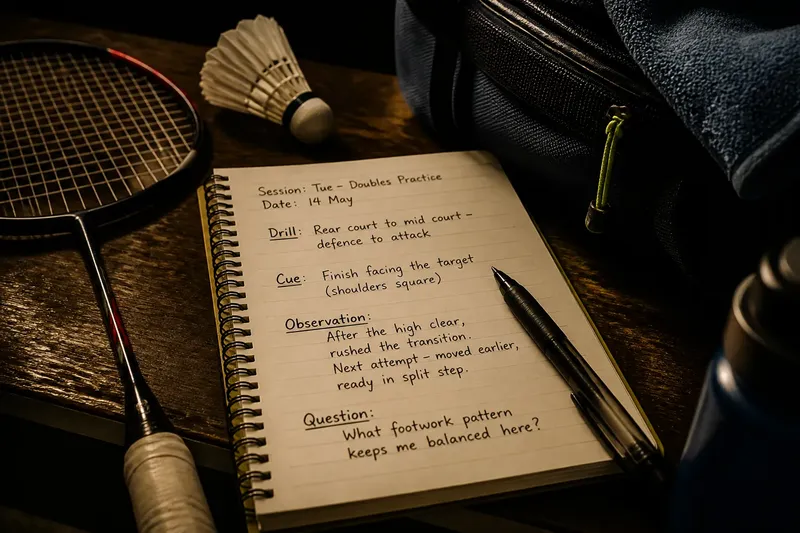
You leave a badminton court remembering the rally where your feet stopped moving, but not the coach’s exact cue. Practice notes can preserve that feedback in words you can use at your next session, without trying to record every shot.
The most useful note connects a specific situation with an action, an observation or a question. It should also remain clear to you later, when the coach is no longer beside you to explain it.
What belongs in a practice note?
A compact entry can hold three kinds of information: the context, the cue and what you noticed. The context tells you where the cue applies; the observation helps you remember what happened when you tried it.
- Context: Name the drill, passage, movement or situation.
- Cue: Write the action or sensation to attend to.
- Observation: Record what you noticed, without judging the entire session.
- Question: Add anything you need to clarify with a coach or training partner.
For instance, “backhand return; turn shoulders earlier; saw the ball sooner on the next attempt” records a setting, an action and an observation. If the cue would be hard to understand later, add a few words about when to use it.
How can you make a coach’s feedback usable?
Feedback is easier to apply when it points to something you can recognise during the activity. “Be better” does not indicate what to do, while “finish facing the target” identifies an action to check.
If a coach uses shorthand such as “stay loose”, ask what part of the movement or body they mean. You can write the explanation in your own language, then confirm that your wording still matches the coach’s intended cue.
Say you are learning a pottery wheel and find that you press too hard as the clay wall rises. You note, “As the wall lifts, ease pressure and watch its thickness.” At the next session, you try that cue and observe whether the wall stays more even; if the phrase remains unclear, you ask the instructor to demonstrate the pressure they mean.
How do you choose what to record during practice?
Do not stop in the middle of a task to write a full account. If a cue or question is easy to forget, jot down a few words on a card or in a notebook during a natural pause, then add context afterwards.
Choose a format that suits the activity. A pocket notebook can be handy between drills; a phone note or voice memo may suit a quiet break, but avoid using a device where it distracts you or conflicts with the activity’s safety rules.
Use this decision list when deciding what an entry needs:
- If you will not recognise the drill later, add its name; if you will recognise it, leave the context brief.
- If the cue names an action you can notice, keep it; if it says only “try harder”, ask for a specific action instead.
- If you observed a change or difficulty, record what happened; if nothing stands out, do not invent an observation.
- If a coach’s phrase is unclear, write down your question; if you understand it, note the cue in your own words.
- If the cue applies only in a certain situation, name that situation; if it applies throughout the drill, say so plainly.
- If writing interrupts the activity, capture a keyword at a safe pause; if it still distracts you, wait until practice ends.
How should you review practice notes?
Before a related session, read the entry and ask whether its cue still fits, whether you know what action to take and whether the observation raises a question. If any answer is no, revise the wording or ask the coach to clarify it.
Imagine a learner returns to a notebook entry reading, “rushes transition”. The starting note does not say when the rush occurs, so the learner adds, “after the high ball, before the next shot”. At the following practice, they watch for that moment; if they still cannot tell what action to take, they ask the coach to identify a suitable cue rather than guessing at a technical change.
Repeated notes can suggest a useful question, but they do not explain the cause on their own. Keep the observation separate from a judgement about your ability: “missed the turn after the bridge” is more actionable than “hopeless at navigation”.
What do people ask about practice notes?
Should I write notes after every session?
No. Record a cue, observation or question that is likely to help you later, and skip routine details that add nothing. A selective record is easier to revisit than a transcript of every attempt.
Are handwritten notes better than phone notes?
Neither format suits everyone. Choose a notebook, phone note or voice memo according to what is accessible during a safe pause and easy for you to review later.
What should I do if a coach’s cue does not make sense?
Ask for a demonstration or a description of what to notice. Write the explanation in words you understand, then check that it still points to the intended action.
When should I change a practice note?
Revise it if it is unclear, no longer applies or repeatedly draws your attention away from the task. If it refers to a coach’s technical instruction, check before replacing it with a different movement cue.
How can you tell whether a note is clear?
Read it as if you were returning to it after a gap: can you identify the situation, the action and what you meant to observe? If not, add the missing detail rather than making the entry longer in general.
Good practice notes make feedback easier to revisit without pretending that a few lines explain everything about a skill. For practice notes that help at the next session, keep the cue tied to a recognisable moment and leave yourself one clear question when something remains uncertain.